Getting started
Chair Yoga: Getting Started Safely
How to start chair yoga at home - choosing the right chair, setting up safely, five simple seated movements to try and when to check with a professional first.
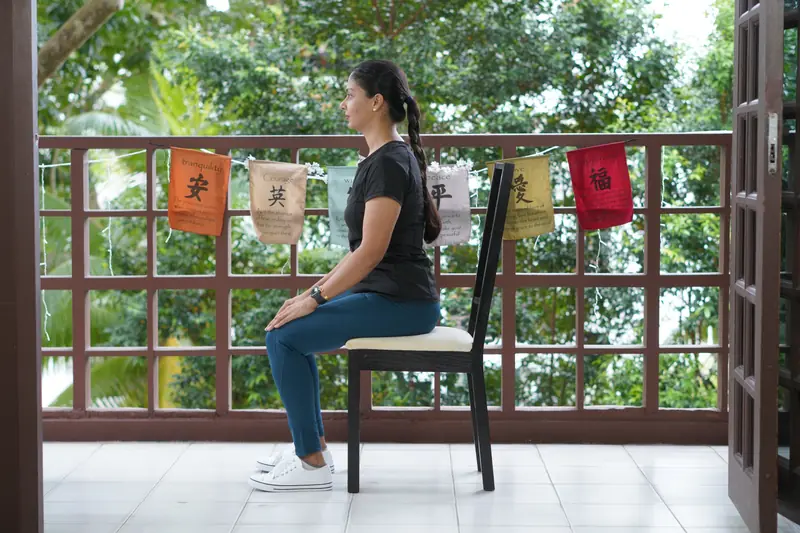
Chair yoga brings yoga off the floor. You practise sitting on a chair, or standing while holding it for support. It is a practical option if getting down to the floor is difficult, if you would like extra support for balance, or if you simply prefer a seated practice.
This guide explains how to set up safely and gives you a few simple movements to start with.
Choosing the right chair
The chair matters more than anything else. The NHS guidance on sitting exercises recommends a solid, stable chair that doesn't have wheels, at a height where you can sit with your feet flat on the floor and your knees bent at right angles. Chairs without arms are ideal, because arms can restrict your movement.
In practice, a firm dining chair is often perfect. Avoid:
- office chairs with wheels or a swivel seat,
- folding chairs that could collapse or tip,
- rocking chairs, and
- deep, soft armchairs that you sink into.
If your feet don't reach the floor comfortably, rest them on a firm cushion or a thick book.
Setting up your space
- Place the chair on a non-slip surface, or against a wall so it can't slide backwards.
- Clear space around you so you can stretch your arms out to the sides and in front.
- Wear comfortable clothing and keep a glass of water nearby.
- If you will do any standing movements, check the chair is stable enough to hold onto.
How to sit
Sit towards the front half of the seat, with your feet flat and hip-width apart. Lengthen up through your spine without leaning on the backrest. Let your shoulders relax down and rest your hands on your thighs. This upright seat is your starting point for most movements.
Five simple movements to try
Move slowly, breathe steadily and only go as far as feels comfortable. Repeat each movement a few times.
1. Seated breathing
Rest your hands on your belly. Breathe in gently through your nose and feel your belly expand; breathe out slowly. Don't force the breath. Continue for a minute.
2. Arm raises
Breathing in, sweep your arms forward and up, as high as is comfortable. Breathing out, lower them. If your shoulders are stiff, raise them only to shoulder height.
3. Seated cat-cow
With your hands on your knees, breathe in and gently lift your chest, drawing your shoulders back. Breathe out and round your back, letting your chin drop slightly towards your chest. Keep the movement small and smooth.
4. Gentle seated twist
Sit tall. Place your right hand on the outside of your left knee and your left hand on the side of the chair seat. Breathing out, turn gently to the left, leading with your chest rather than your head. Return to the centre and repeat on the other side. Only turn as far as is comfortable.
5. Ankle circles and marching
Lift one foot slightly off the floor and slowly circle the ankle in each direction. Then, holding the sides of the chair, gently "march" by lifting one knee and then the other. Keep your back upright and avoid leaning back.
Optional standing support
If you are comfortable standing, you can use the back of the chair for support in simple standing poses. For example, stand behind the chair with both hands on the backrest and gently rise onto your toes, then lower slowly. Make sure the chair is stable, and sit down whenever you need to.
Signs to stop
Stop and rest if you feel:
- pain (rather than a gentle stretch),
- dizziness or light-headedness,
- numbness or tingling,
- unusual shortness of breath, or
- anything else that doesn't feel right.
If symptoms continue, seek medical advice.
Getting guidance
Practising with a teacher helps you learn good habits from the start. Our live chair yoga classes are taught entirely with a chair, with optional standing poses. If you would prefer one-to-one guidance, a private session can be planned around what's comfortable for you.
For more ideas on adapting poses, see gentle yoga modifications for different ability levels.
This article is general information and is not a substitute for individual advice from a qualified healthcare professional.